
Services

Focused services for critical platform change.

Focused support for enterprise programmes where data, integration, governance and delivery decisions need to be made clearly, evidenced properly and executed safely.

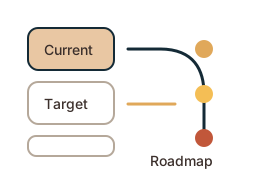
Enterprise data architecture and roadmap

For organisations where data architecture needs to become a decision and delivery capability, not a slide deck.
When this matters

A major platform change has exposed inconsistent data structures, ownership gaps or unclear reporting dependencies.

How Pattern Bridge helps

Pattern Bridge clarifies the current data landscape, target structures, ownership assumptions, platform implications and the sequence of decisions needed to move safely.

What you get
  • Current state data architecture view
  • Target architecture narrative
  • Decision and risk register
  • Roadmap by phase and decision point
Relevant experience

Mikhail has shaped enterprise data architecture and integration delivery across ERP, HCM, CRM, payroll and custom platform transformations, including remediation sequencing across large application and database estates.

How the work stays focused

Architecture is kept tied to business decisions, delivery plans and accountable ownership.

Governance, MDM and data quality controls

For organisations where governance policies exist, but delivery still lacks ownership, evidence and working controls.
When this matters

Policies and forums exist, but testing, cutover, reporting or sign off still depend on disputed definitions and inconsistent evidence.

How Pattern Bridge helps

Pattern Bridge turns governance intent into ownership maps, quality thresholds, exception handling, readiness gates and evidence packs that teams can actually use.

What you get
  • Governance control model
  • Critical entity and ownership map
  • Data quality threshold set
  • Readiness and sign off evidence model
Relevant experience

Mikhail has defined canonical structures across customer, membership, product, payments and workforce data, and has established reconciliation and readiness controls in high volume transformation programmes.

How the work stays focused

Governance remains operational, testable and proportionate to programme risk.

Integration architecture and system interfaces

For programmes where critical systems must exchange trusted data and the interface design needs to hold under operational pressure.
When this matters

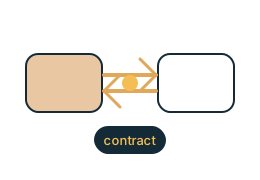
Suppliers are progressing interfaces, but data contracts, behaviours, exceptions, monitoring or ownership are not explicit enough.

How Pattern Bridge helps

Pattern Bridge defines integration architecture, interface catalogues, data contracts, service boundaries, exception handling, reconciliation controls and support ownership.

What you get
  • Interface catalogue
  • Data contract templates
  • Data flow and sequence views
  • Exception and support model
  • Integration readiness checklist
Relevant experience

Mikhail has defined Oracle HCM to ADP payroll integration architecture and worked across Salesforce, Zuora, Commercetools, Workday, Oracle, APIs, file based pipelines and Azure supported delivery.

How the work stays focused

The service designs and assures integration behaviour. It is not presented as a full platform engineering squad.

Data migration, cutover and delivery assurance

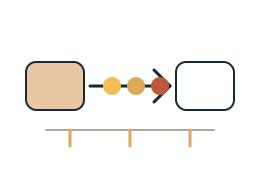
For enterprise platform change where migration risk, data readiness and go live evidence can decide whether the programme succeeds.

When this matters

Cutover is approaching and readiness evidence is fragmented across suppliers, systems, data domains and business owners.

How Pattern Bridge helps

Pattern Bridge shapes migration architecture, staging logic, validation rules, reconciliation evidence, cutover checkpoints and the decision cadence around go live.

What you get
  • Migration architecture and assurance model
  • Mapping and validation standards
  • Cutover readiness framework
  • Go live evidence pack
  • Decision, issue and risk register
Relevant experience

Mikhail led migration of 57 million plus records to a multi cloud platform within a fixed 10 day cutover window, and has stabilised governance on delayed payroll delivery.

How the work stays focused

Assurance focuses on evidence and decision quality, not masking residual risk.

Ways to engage

Proportionate to the decision.

Focused diagnostic

Two to four weeks to assess data, integration, governance or migration risk and recommend next steps.

Decision point review

Two to ten days to review an architecture decision, integration design, vendor proposal or go live readiness issue.

Integration and service design sprint

Two to six weeks to define contracts, service boundaries, exception handling and readiness criteria.

Stabilisation sprint

Four to eight weeks to reset ownership, cadence, controls and evidence where risk is drifting.

Embedded principal leadership

Three to six months operating inside the programme as principal data, integration or assurance lead.

Architecture assurance cadence

Ongoing cadence to review data, integration, governance and readiness decisions as delivery moves.

Need a service shaped around a live programme risk?

Start with the decision, evidence gap or integration issue that needs clearer control.

Talk through the situation